Zamora
Conan the BarbarianZamora is the ancient, wicked kingdom of the Hyborian Age that stands as the great antithesis to Conan's native Cimmeria. It is a land of shadowed secrets, furtive spies, profound philosophers, depraved kings, and sloe-eyed women—a place where civilization itself is steeped in splendid sin. For Conan, Zamora is the threshold of the civilized world, the destination whispered to him in a moment of passion, and the stage upon which he first confronts the seductions and corruptions of urban life. Its capital, Shadizar, is called the crossroads of the world, a city where all the caravans of the earth converge, laden with the riches of distant kingdoms, and where the conflict between the traditional authority of King Osric and the charismatic power of the cult leader Thulsa Doom comes to a head.
Geography and the Road to Zamora
Zamora lies to the south of the northern lands where Conan was enslaved, and its approach is marked by a gradual transition from the bleak north to a darkling land of mystery. The border of Zamora is reached after days of travel, and it is there that Conan and his companion Subotai first glimpse the kingdom. Subotai, a Hyrkanian, describes the land with a mixture of awe and greed: south lies Zamora, to the west is Brythunia, and to the east, following the river, lies the territory of Turan. In Zamora, Subotai explains, cross all the caravans of the world, bearing superb carpets from Iranistan, spiced fruits from Turan, the famed pearls of Khosala, gems from the iron hills of Vendhya, and the heady wines of Shem. This is civilization—ancient, wicked, and steeped in splendid sin—and Subotai asks Conan whether he has tasted its pleasures or seen its lofty towers and teeming bazaars.
The journey into Zamora passes through the frontier town of Yazdir before reaching the inner cities. Conan and Subotai maintain a tireless pace, walking and jog-trotting for hours, though the barbarian with his longer legs could easily outpace his bow-legged companion. Subotai grumbles about walking like a mere peasant instead of riding like a proper Hyrkanian warrior, and whenever they pass horses grazing in a field, he suggests stealing a couple. Conan, who has never ridden any animal, turns the idea aside. The journey itself is a passage from the wild into the settled, from the world of the Pit and the Wheel into the world of commerce and intrigue.
Shadizar, the City of Thieves
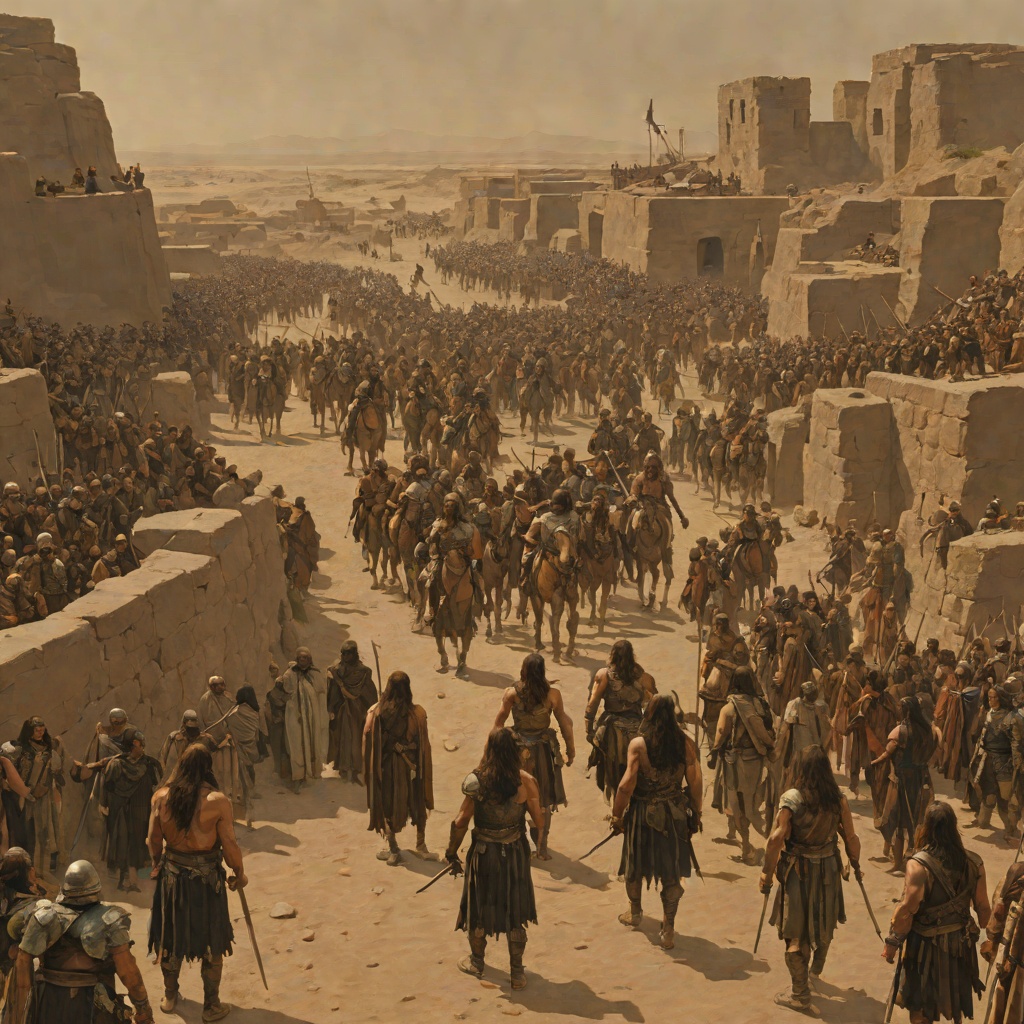
At length the travellers come to the capital—Shadizar, the city of thieves, the abode of rogues. Here dwell, in comparative safety, all the outlaws of the western world, including escaped slaves, exiles, and men with a price on their heads, for here they can safely hide if they have the price and know their ways around. Conan finds himself in the midst of a colourful throng, rubbing shoulders with merchants in rich robes, artisans hawking trays of brass ornaments, gems, and weapons, bearded farmers in rough homespun guiding wains laden with sacks of wheat and barley, sides of beef, and trussed, grunting pigs, stiff-backed soldiers, mobile-hipped whores, beggars, urchins, and priests. He sees squat Shemites with curly beards, lean Zuagirs in head cloths, kilted Brythunians, booted Corinthians, and turbaned Turanians. Conan is amazed; Shadizar far surpasses Yazdir in size and variety as Yazdir surpassed the towns of his Pit-fighting days. Never has he seen such a bewildering array of folk, and it seems to him that here is gathered a sampling of all the divers peoples of the earth.
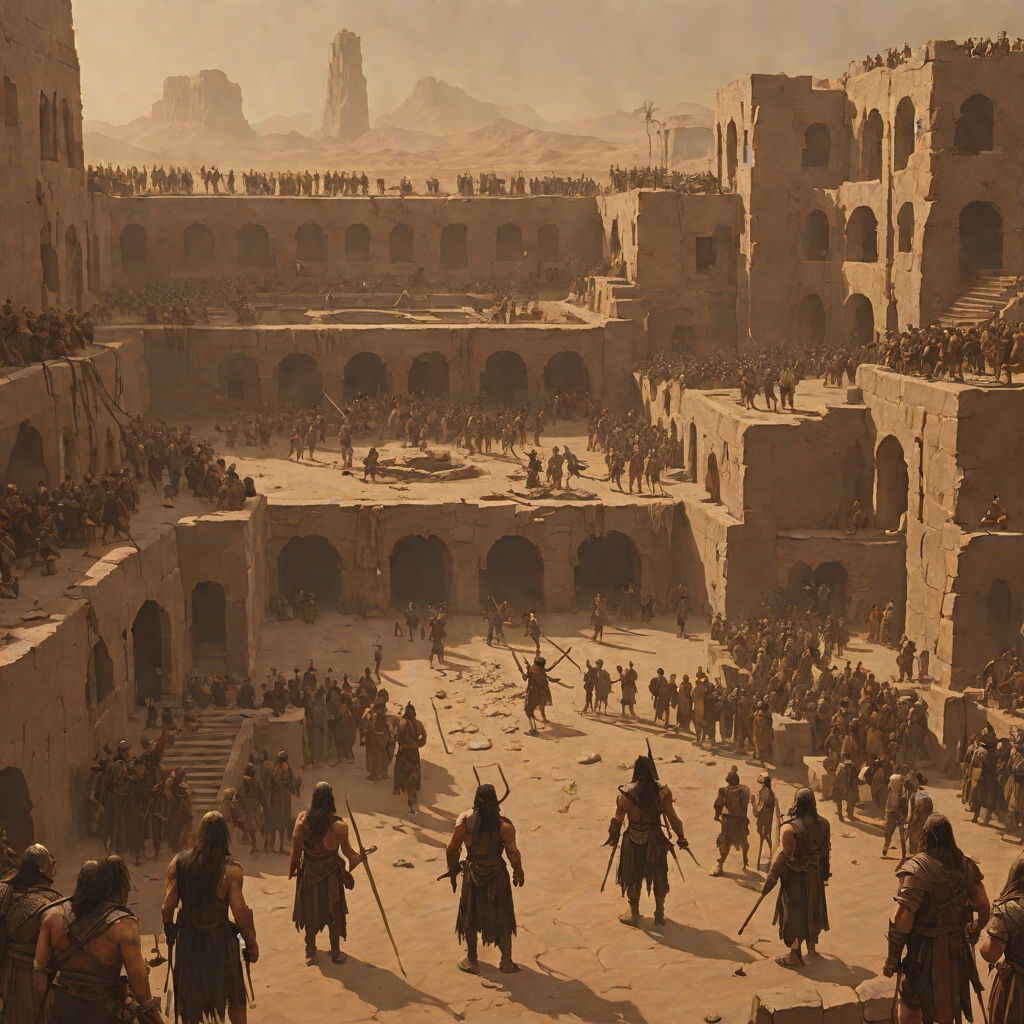
Nor has he seen anything to equal the city's broad boulevards, pillared temples, domed palaces and mansions, and lush, walled gardens. He marvels that so many could dwell crowded together thus, without turning on one another to rend and slay, like savage beasts. Yet not all sections of the city are so beautiful as the estates of the great lords and princes, with their marble columns and glimpses of parks and gardens. In the back streets he discovers crooked alleys swarming with hags and pimps, with painted children for sale to degenerates, with the poor and the ill. Here flesh is for sale, or at least for rent, and every pleasure, however decadent, can be had for money. In these back streets lurk violence and sudden death, as well. Once, as Conan and Subotai stride through the crowd, a woman screams, men curse and scuttle away on furtive feet, and the two find themselves alone in the narrow way with their hands on the hilts of their blades. At their feet, a man writhes as he clutches a wound in his belly from which a steady stream of blood trickles through his fingers.
The Cult of Set and the Court of Osric
Zamora is also the stronghold of the Cult of Set, the serpent-worshipping religion that has ensnared the young and innocent of the kingdom. Subotai, spitting on the pavement, denounces the cultists as fools and madmen, snake-lovers, and death-worshippers. Everywhere in these lands, he says, they rear those dark towers, the citadels of Set, and always it is the same: they lure the young and innocent into their toils, innocents who forsake husbands, sweethearts, and family to make love with serpents and mad priests in orgies of foulness. The cult's reach extends even to the royal family. Princess Yasimina, daughter of King Osric and heir to the Ruby Throne, has become a high priestess of Set, entrapped long ago by the priests with their lies and drugs. Subotai warns that death lurks behind those dreamy eyes, and that the cultists are deceivers all, whispered to fall in with strangers on the road to strangle them as they sleep or to stab them in the dark, all for the honour of their slithering god.
The cult's presence in Zamora is a source of profound anguish for King Osric, who chafes at the presence of this demigod Thulsa Doom in his poor kingdom. Snakes in his beautiful capital, he laments; to the west, to the south, in Brythunia, Corinthia, everywhere snakes, everywhere these black towers with their black-hearted priests. They steal away the children and turn them into monsters, into reptiles like the snakes they worship, and the corrupted young raise their envenomed fangs against their very parents. Osric's own guards dare not stand against them; his bravest warriors, his fiercest fighting men shrink from their duty and fail in their sworn allegiance. The king, a weak old man beset by problems he cannot solve, is reduced to calling on thieves to save his kingdom. He shows the companions a thin bronze-handled dagger with a blade that undulates like the body of a serpent—the serpent's fang, thrust into his father's heart by his younger son, his own brother, who has been ensorcelled by the cult's witchcraft. And his own daughter, the jewel of his kingdom, the joy of his old age, has likewise fallen under the spell of Thulsa Doom, and he wonders whether she bears a dagger such as this, pointed at his heart.
The Clash of Authorities
The conflict between King Osric and Thulsa Doom is a clash between two forms of authority. Osric represents traditional authority, the hereditary king of Zamora, but his power has been hollowed out by the cult's influence. His guards shrink from their duty, his warriors fail in their sworn allegiance, and he is left trembling and querulous, a weak old man who must call on thieves to save his kingdom. In contrast, Thulsa Doom exercises charismatic authority, based on his personal magnetism and perceived supernatural powers. In the cult's rituals, Doom raises his arms majestically and turns his palms down, and the chanting ceases upon the instant of the gesture. His resonant voice rises and falls like the tolling of a bell as he asks his followers who amongst them fears the warm embrace of death, whether they will strike true to the infidel heart, whether it be the heart of friend, or lover, or loved one in their former life. The entranced faces, upturned in ecstasy, moan in rhythm to the beat of his utterances: "Doom! Doom!" The catechism continues, asking whether they will slip the silken noose over the heads of Set's enemies, stay true ignoring the blandishments of the leaders, judges, and parents who have taught them falsely, and clutch the hilts of their daggers to spill the heart's blood of the infidels.
Doom's authority is demonstrated in a chilling display before Conan. When a young girl, at Doom's command, leaps from a wall and falls with a heavy thud on the tiles of the garden walk below, Doom laughs, the music of his laughter spun through with a note of triumph. He declares: "That is strength, boy—that is power! It is strength against which the hardness of steel or the resilience of human flesh are as naught. What is steel, compared to the hand that wields it; what is the hand, without a mind to command it? There is the secret of strength. Steel, bah!" This is the doctrine that challenges the very foundation of Conan's worldview, the riddle of steel taught to him by his father Corin on a storm-swept ridge in Cimmeria, where the secret of steel was revealed as the greatest of Crom's secrets, a secret the gods taught not to men but jealously guarded in their inmost hearts.
The cult's ambition extends to the throne itself. The priest Yaro, taking a step closer to the throne, announces that Thulsa Doom, the true prophet of Set the Eternal, wishes to honour Osric's house by marriage with his daughter, the Princess Yasimina. Osric reacts with shrill fury, clawing at his beard with a shaking hand, denouncing the proposal as monstrous and the priest's effrontery as surpassing all belief. The marriage, if it were to occur, would unite the cult's charismatic authority with the traditional legitimacy of the royal line, a prospect that horrifies the king. This confrontation crystallizes the political crisis of Zamora: a traditional monarch whose authority has been eroded, facing a charismatic leader whose power over the young and the innocent threatens to supplant the old order entirely.
Significance in Conan's Journey
Zamora is the crucible in which Conan's understanding of civilization is forged. It is the place where he first learns that a man can trust no one, neither man nor woman nor beast, neither spirit nor demon nor god, but only a blade of well-forged steel—the lesson his father taught him on the ridge, that the heart of a man is like a piece of unworked iron, to be hammered by adversity and forged by suffering. In Zamora, Conan encounters the full spectrum of human corruption and vitality, from the teeming bazaars to the crooked alleys where flesh is for sale, and he sees firsthand the power of the Cult of Set to seduce and destroy. The city is also where he is drawn into the service of King Osric, setting the stage for his infiltration of the Mountain of Power and his final confrontation with Thulsa Doom. Zamora, with its ancient wickedness and splendid sin, is the necessary counterpoint to Conan's barbaric integrity—the place where the riddle of steel is tested against the claims of charismatic power, and where the barbarian must decide what he truly trusts.